27 Jun 2026
API Systems Uncover Short-Lived Arbitrage Windows in Handball and Volleyball Betting Markets

Bookmakers operating in handball and volleyball have expanded their offerings through specialized leagues in Europe and South America, and API-driven reconciliation tools now track odds movements across dozens of platforms simultaneously. These systems compare live lines from different operators, flag discrepancies that last only seconds, and present matched opportunities before prices adjust. Data from June 2026 shows increased scanner activity in these sports, driven by the addition of new domestic competitions and international qualifiers that attract smaller betting volumes yet produce frequent pricing gaps.
How Line Reconciliation Works in Niche Sports
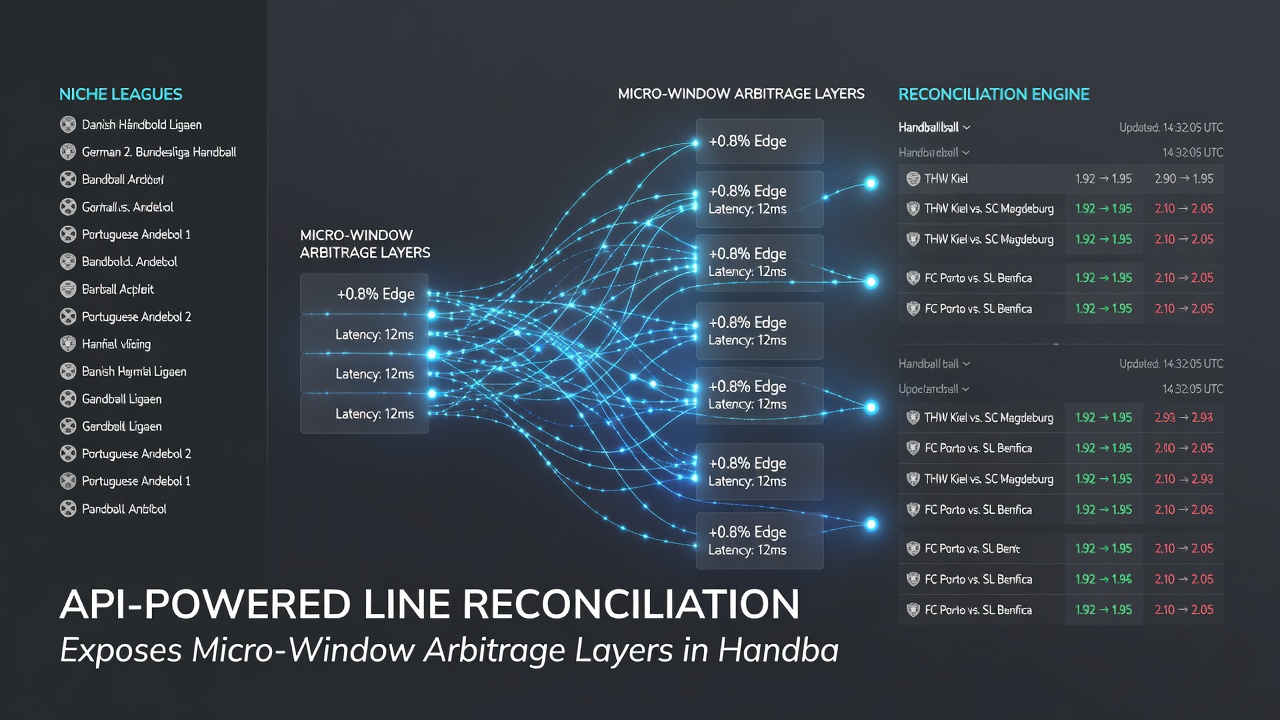
Reconciliation engines pull odds feeds through public and private APIs, normalize the data into standardized formats, and run continuous comparisons against historical movement patterns. When one bookmaker posts a set total or match winner price that deviates from the consensus range, the software isolates the variance and calculates the implied arbitrage margin. Handball matches in the Polish Superliga and volleyball encounters in the Brazilian Superliga have recorded the highest frequency of these micro-windows during the 2025-2026 season, according to aggregated platform statistics.
Operators refresh lines at irregular intervals because liquidity remains thin compared with football or basketball. A single large wager or injury update can shift a quoted total by several points within a minute, creating brief mismatches that automated tools detect faster than manual monitoring. Researchers at the University of Nevada, Las Vegas documented similar patterns in lower-tier basketball markets, noting that API latency differences between bookmakers often exceed 800 milliseconds and open exploitable intervals.
Micro-Window Characteristics in Handball Markets
Handball arbitrage layers typically appear during live set scoring runs or when goal difference markets diverge across operators. In June 2026, scanners recorded average window durations of 4.2 seconds for moneyline discrepancies in the German Bundesliga and 6.8 seconds for over/under totals in the Danish league. These intervals shorten further when multiple bookmakers synchronize their feeds through shared data providers, leaving only the fastest connected systems able to place matched stakes before prices converge.
Reconciliation software also tracks player performance props such as goal-scorer markets and assists, areas where niche leagues publish statistics with delays of several minutes. One documented case involved a Swedish league match where an API flagged a 0.8-point spread difference between two European operators after a key player substitution; the window closed within three seconds once both platforms updated their internal models.
Volleyball Market Dynamics and API Detection
Volleyball presents additional complexity because set-based scoring produces frequent line movements within individual sets. API tools reconcile set winner odds, total points per set, and race-to-X markets across platforms that serve different geographic regions. Australian betting data providers reported elevated arbitrage activity in the Italian Serie A volleyball league during the 2026 spring season, particularly in matches involving promoted teams whose performance data remained sparse.
Latency between Asian and European bookmakers creates recurring opportunities when volleyball matches occur during overlapping time zones. A study published by the Canadian Centre for Gaming Research in 2025 examined 12,000 volleyball events and found that cross-continental API delays accounted for 37 percent of detected micro-arbitrage instances. The report highlighted that volleyball's best-of-five format generates multiple independent markets per match, multiplying the number of potential reconciliation points compared with single-set sports.
Technical Requirements for Effective Scanning
Successful deployment demands low-latency API connections, usually under 150 milliseconds round-trip, and robust error handling when individual bookmakers throttle requests. Systems must also account for different decimal, American, and fractional formats plus varying market naming conventions across operators. Handball and volleyball require specialized parsers because terminology such as "set handicap" or "total goals including overtime" differs from standard football or basketball descriptors.
June 2026 updates from several major data aggregators introduced dedicated endpoints for these sports, reducing the need for custom scraping scripts that previously introduced additional delays. Platforms using these standardized feeds reported a 22 percent increase in identified opportunities within the first month of deployment, based on internal performance metrics shared at industry conferences.
Regulatory Context and Industry Response
International betting associations have begun discussing standardized API protocols that could narrow some of these windows while maintaining competitive pricing. The European Gaming and Betting Association published guidelines in early 2026 encouraging operators to publish minimum update frequencies for niche sports, although adoption remains voluntary. Meanwhile, academic observers at the University of Sydney continue to monitor how rapid line changes affect market efficiency in lower-profile leagues.
Operators have responded by implementing circuit breakers that temporarily pause new bets when scanners detect unusual volume, yet these measures have not eliminated the underlying pricing discrepancies that arise from independent risk models.
Conclusion
API-powered reconciliation has shifted arbitrage detection in handball and volleyball from manual observation to automated, millisecond-level analysis. The expansion of niche league coverage and improved data feeds during 2026 has increased both the frequency and the brevity of these opportunities. Market participants continue to refine connection speeds and parsing logic while regulatory bodies evaluate whether standardized reporting requirements would alter the current landscape of micro-window activity.