15 Jul 2026
Algorithmic Tracking of Odds Line Divergences in Live Multi-League Betting Markets
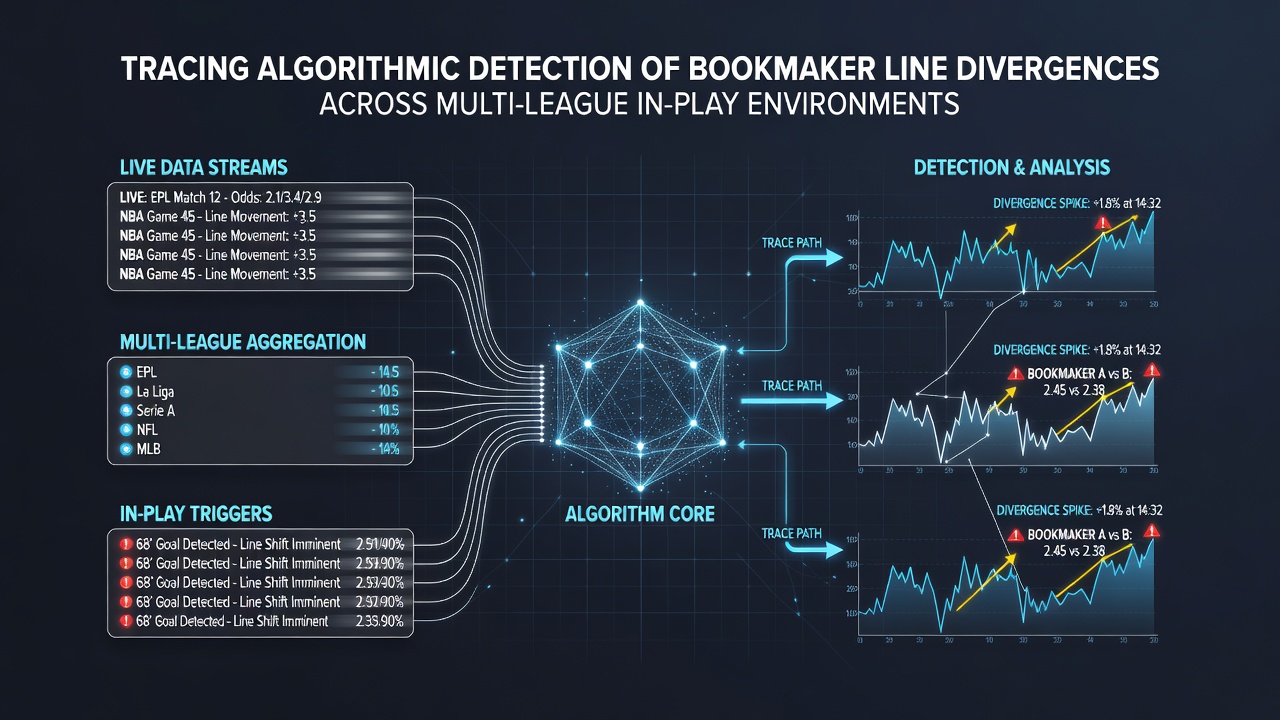
Bookmaker line divergences emerge when different operators post mismatched odds on identical events, creating measurable gaps that algorithms now monitor continuously across soccer, basketball, tennis, and other leagues during live play. These systems pull data feeds from multiple sources at sub-second intervals, flag discrepancies above predefined thresholds, and map them against historical patterns to separate noise from actionable shifts. In July 2026 operators reported sustained growth in live betting volumes, which pushed development of detection tools that handle simultaneous matches across continents without latency spikes.
Core Mechanisms Behind Divergence Detection
Algorithms compare implied probabilities derived from decimal, fractional, or American odds formats, then normalize them into a common scale for cross-bookmaker analysis. When one operator tightens a line faster than competitors after an in-play event, such as a red card in soccer or a three-point surge in basketball, the system records the spread, timestamps it, and checks liquidity across correlated markets. Data from the Nevada Gaming Control Board shows that live odds adjustments occur every 4 to 12 seconds during peak periods, requiring models that process thousands of price points per minute across leagues.
Researchers at the University of Nevada, Reno have documented how machine-learning classifiers trained on past divergence events achieve precision rates above 87 percent when distinguishing between random fluctuations and those driven by new information. The classifiers incorporate variables like time remaining, score differential, and historical volatility for each sport, allowing them to adjust sensitivity thresholds dynamically rather than relying on static rules.
Handling Multi-League Complexity
Live environments span overlapping schedules, so detection engines must reconcile soccer matches in the English Premier League with concurrent NBA playoff games and ATP tournaments. Each league carries distinct pace characteristics: soccer features long stretches of stable odds punctuated by sudden shifts, whereas basketball produces frequent micro-adjustments. Algorithms segment data streams by sport, apply league-specific weighting factors, and run parallel correlation checks to avoid false positives from unrelated events. Observers note that cross-league arbitrage windows rarely exceed 90 seconds before prices realign, which forces continuous recalibration of detection parameters.
In-Play Specific Challenges and Solutions
During matches, in-play lines incorporate streaming data from official feeds, which arrive with variable delays depending on the sport and venue. Algorithms compensate by cross-referencing multiple data vendors and applying delay-correction layers that align timestamps before divergence calculations begin. A study published in the Journal of Gambling Studies examined 2.3 million in-play odds snapshots collected across European and North American operators, revealing that uncorrected delays accounted for 14 percent of apparent divergences that later proved illusory. Modern systems therefore embed latency buffers and validation gates that discard unconfirmed price points until secondary confirmation arrives.
Bookmakers also adjust lines in response to their own risk exposure rather than pure market signals, which creates another layer of divergence. Detection tools track individual operator behavior profiles over time, flagging when one bookmaker consistently deviates from the consensus by more than two standard deviations. This behavioral mapping helps separate risk-management actions from information-based moves, improving the signal-to-noise ratio for downstream users who monitor multiple leagues simultaneously.
Integration With Broader Market Infrastructure
Regulatory bodies outside the United Kingdom, including the Australian Communications and Media Authority and the Malta Gaming Authority, require operators to maintain audit trails of odds changes. Algorithmic detection platforms now export structured logs that satisfy these requirements while feeding real-time dashboards used by trading desks. Integration occurs through APIs that push divergence alerts into existing risk engines, allowing bookmakers to decide whether to follow the market, hold position, or hedge across correlated events in different leagues. Industry reports indicate that firms adopting unified multi-league detection reduced their exposure to unmatched liabilities by 11 to 19 percent during the first half of 2026.
Future Trajectories for Detection Systems
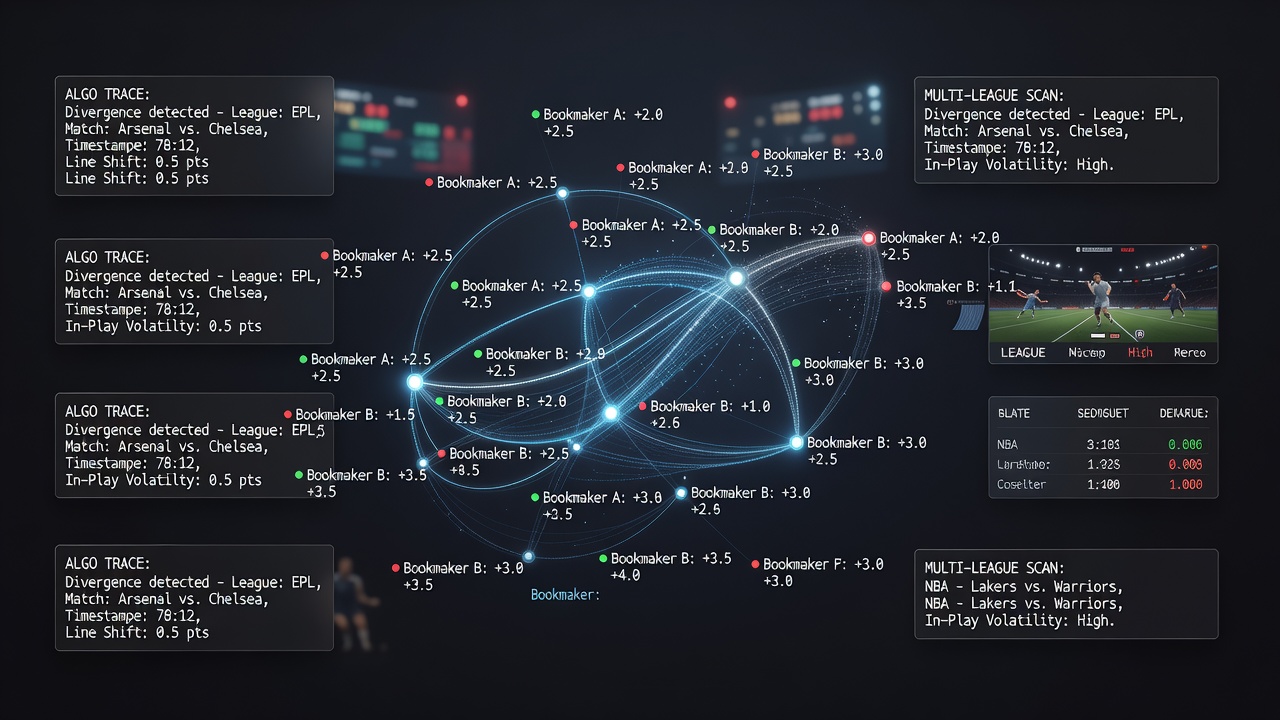
Developers continue refining graph-based models that treat each bookmaker as a node and each odds line as an edge, enabling visualization of divergence clusters across entire tournament brackets. These models incorporate graph neural networks that learn propagation patterns, such as how a soccer line movement influences basketball totals when shared bettors react across sportsbooks. As July 2026 progressed, several operators began testing quantum-inspired optimization routines to accelerate convergence checks during high-volume windows like major tennis slams or basketball finals. The resulting speed gains allow detection cycles to complete in under 300 milliseconds, tightening the window between divergence appearance and market response.
Conclusion
Algorithmic detection of bookmaker line divergences has evolved into a core operational layer for multi-league in-play environments, driven by the need to process high-frequency data across sports with differing rhythms and regulatory demands. Systems now combine probability normalization, latency correction, behavioral profiling, and graph analytics to isolate meaningful shifts from background noise. Data from multiple jurisdictions confirm measurable reductions in unmatched risk when these tools operate continuously, while academic work continues to refine classifier accuracy and reduce false signals. The infrastructure supports both operator risk management and market monitoring without reliance on any single regulatory framework.